Not every electric bike is the same, and that matters...
E-Bike Classification, Safety, and Why the Conversation Matters
There’s no denying that electric bikes are changing transportation for the better. They help people commute without a car, reduce fuel costs, make cycling accessible to more riders, and give students and workers an affordable way to get around. For many people, e-bikes are the difference between staying active and staying stuck behind the wheel.
But lately, e-bikes have been making headlines for all the wrong reasons.
Every time there’s a serious accident involving an electric motorcycle or high-powered off-road machine, the term “e-bike” gets thrown around in the news. Unfortunately, that creates confusion for the public and lawmakers alike. Responsible Class 1 and Class 3 e-bike riders are increasingly being lumped in with unregulated electric motorcycles that were never designed to operate like bicycles in the first place.
That distinction matters.
As conversations about restrictions and bans continue across California and beyond, it’s important for people to understand the actual classifications of e-bikes, how the law views them, and why irresponsible use of electric motorcycles is creating problems for everyone else.
Understanding E-Bike Classifications
In California, legal electric bicycles generally fall into three categories.
Class 1 E-Bikes
Class 1 e-bikes are pedal-assist only. The motor provides assistance while the rider pedals, but stops assisting at 20 mph.
These are widely considered the safest and most universally accepted type of e-bike. They’re ideal for bike paths, recreational riding, commuting, and riders who simply want help climbing hills or traveling longer distances.
Class 2 E-Bikes
Class 2 e-bikes include a throttle and can propel the bike without pedaling, but are still limited to 20 mph.
These are common among commuters and riders who may have physical limitations that make pedaling difficult.
Class 3 E-Bikes
Class 3 e-bikes are pedal-assist bikes capable of assisting up to 28 mph. They do not rely solely on a throttle and are intended primarily for road and commuting use.
These bikes have become extremely popular with commuters because they allow riders to realistically replace short car trips while still following the structure of a bicycle.
The important thing to understand is this:
Class 1, 2, and 3 e-bikes are regulated. They have speed limits. They have rules. They are legally defined.
That’s very different from many of the machines now being marketed online as “e-bikes.”
The Real Problem: Unregulated E-Motos
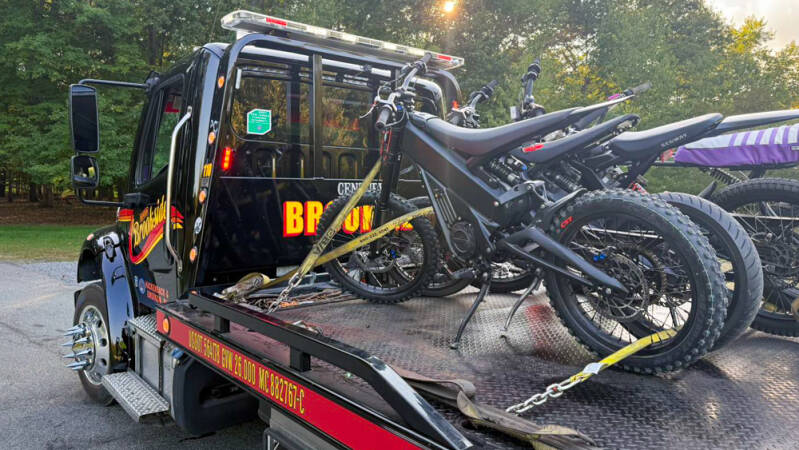
A large portion of the dangerous riding videos circulating on TikTok and Instagram are not showing legal e-bikes. They’re showing high-powered electric motorcycles — often referred to as e-motos.
Brands like Talaria, SurRon, E Ride Pro, and similar companies have exploded in popularity online, especially among teenagers. Social media influencers market these machines as fun, rebellious, and exciting, often blurring the line between motorcycle and bicycle.
The problem is that many parents don’t realize what they’re actually buying.
These machines are capable of speeds reaching 50 to 60 mph or more. Many of them don’t even have functional pedals. Some are essentially lightweight electric dirt bikes being marketed with bicycle language to avoid scrutiny.
That creates a dangerous misunderstanding.
A legal Class 1 or Class 3 e-bike is designed around bicycle infrastructure and bicycle laws. An unregulated e-moto operating at motorcycle speeds is an entirely different category of machine.
And unfortunately, many kids riding them are completely unprepared for the risks involved.
Social Media Is Fueling Dangerous Behavior
One of the biggest issues right now is the way these machines are being promoted online.
TikTok and Instagram are full of videos showing teenagers weaving through traffic, performing stunts on public streets, running lights, riding without helmets, and treating busy roads like playgrounds. Those videos rack up millions of views, and younger riders see them as entertainment instead of what they really are: dangerous examples of reckless riding.
Many of these riders don’t wear proper protective gear. Some wear no helmet at all. Others are riding machines capable of highway speeds while mixing with pedestrians, cyclists, and vehicle traffic.
It puts everyone at risk.
It also creates a public perception problem that hurts responsible riders who are simply trying to commute to work or school legally.
Why This Matters for Local Legislation
When lawmakers and universities respond to accidents, they often respond broadly. Instead of targeting illegal or unsafe machines specifically, entire categories of electric transportation end up restricted.
We’re already seeing this happen locally.
Fresno State’s E-Bike and E-Scooter Ban
Fresno State recently passed restrictions on e-bikes and e-scooters on campus in response to growing safety concerns.
While safety absolutely matters, blanket restrictions can create major problems for students who rely on these devices for transportation.
Fresno State is a massive campus. Many students commute long distances, work jobs, attend back-to-back classes, and depend on affordable transportation to navigate campus efficiently. Removing practical transportation options makes daily life harder for students who are already balancing school, work, and financial pressure.
For many students, a Class 1 or Class 3 e-bike isn’t a toy — it’s legitimate transportation.
The issue is that responsible riders are now paying the price for the actions of a smaller group operating unsafe or unregulated machines recklessly.
That’s why the conversation needs nuance.
The Difference Between Responsible Riding and Reckless Riding
Responsible e-bike ownership means:
- Following local laws
- Wearing proper helmets
- Respecting pedestrians
- Riding predictably in traffic
- Staying within legal classifications
- Maintaining the bike properly
Those riders are not the problem.
The problem comes when motorcycle-speed machines are operated illegally on sidewalks, bike paths, school campuses, and public streets without training, registration, insurance, or safety equipment.
Unfortunately, many local bike shops won’t even service these machines because parts availability, liability concerns, and repair complexity are so inconsistent.
That leaves many families stuck with expensive, difficult-to-maintain products that may not even be legal for their intended use.
Why Legal E-Bikes Still Matter
Despite the negative headlines, legal e-bikes still provide enormous benefits.
They reduce traffic congestion. They help people exercise more. They lower transportation costs. They make commuting accessible for people who physically couldn’t ride traditional bikes otherwise. They help people spend less money on fuel and connect more with their communities.
Most importantly, they get people outside and moving.
That’s something worth protecting.
The solution isn’t banning all electric bicycles. The solution is education, enforcement, accountability, and making clear distinctions between regulated e-bikes and high-powered electric motorcycles.
Because when used responsibly, Class 1 and Class 3 e-bikes aren’t the problem at all — they’re part of the solution.
— Enjoy the Ride Bicycles